Learn more about solar lights
Outline:
– Introduction: Why solar lights matter now
– How solar lights work: components, energy flow, and sensors
– Types and use-cases: pathway, wall, spot, flood, string, and more
– Sizing, selection, and placement: metrics, calculations, and site tips
– Care, costs, payback, and conclusion
Why Solar Lights Matter: Convenience, Resilience, and Design
Solar lights have moved from novelty to everyday utility, quietly transforming how we illuminate outdoor spaces. Declining component prices and smarter electronics make them practical for homeowners, renters, and small businesses alike. Over roughly the past decade, LED efficiency has improved markedly, with many fixtures achieving 100–150 lumens per watt in real-world products, while crystalline panels commonly convert about 18–22% of sunlight into electricity. Combine these gains with durable batteries and you get compact fixtures that sip energy yet deliver dependable light.
What sets solar lights apart is simplicity. There is no trenching, conduit, or scheduling an electrician to extend a circuit across a yard. You choose a spot with decent sun, mount the panel or stake the fixture, and let the system charge in daylight for dusk-to-dawn operation. This off‑grid independence also provides resilience: when neighborhood power goes out, path markers, step lights, and motion‑activated floodlights continue to serve safely. That reliability matters on stormy nights and in remote corners where running cable would be costly or disruptive.
Beyond utility, modern solar fixtures are surprisingly versatile. Warm-white garden stakes cast a welcoming glow along beds; wall‑mounted lights brighten side alleys; compact spots highlight trees or house numbers; string lights create ambiance on decks without outlets. Thoughtful features have filtered down, such as adjustable brightness, motion‑triggered boost, and color temperature choices around 2700K for cozy amber or 4000–5000K for crisp visibility. For renters and DIYers, the low commitment is appealing—relocate them as seasons change, or add units incrementally without re‑wiring a thing.
Consider also the long game. A typical wired halogen flood at 60 W running three hours nightly uses about 65 kWh per year; replacing that experience with an efficient solar LED avoids both the energy cost and the emissions tied to grid electricity. Upfront fixture prices vary, but the avoided labor and materials for outdoor wiring can be substantial, especially where hardscape or tree roots complicate trenching. In short, solar lights deliver a mix of convenience, safety, and style with a clear path to long‑term value.
Inside a Solar Light: From Sunbeam to Night Beam
At heart, every solar light is a compact off‑grid system that turns daylight into stored energy, then metes it out carefully after sunset. The process starts with a photovoltaic panel, typically monocrystalline or polycrystalline silicon. Under full sun, a postcard‑sized panel might produce a fraction of a watt to a few watts depending on its area and efficiency. Output is direct current with a voltage that changes with temperature and light intensity, so a small charge controller manages the flow to the battery to prevent overcharge and over‑discharge.
Battery chemistry shapes performance. Many entry fixtures use nickel‑metal hydride (NiMH) cells: affordable, tolerant of cold, and familiar in compact formats. Higher‑end units increasingly rely on lithium iron phosphate (LiFePO4), valued for stable voltage, long cycle life, and thermal safety. NiMH packs often deliver a few hundred cycles under gentle use; LiFePO4 can reach into the low thousands with proper management. Capacity is usually expressed in milliamp‑hours at a given voltage; converting to watt‑hours (Wh = V × Ah) helps compare apples to apples across chemistries.
Between storage and light is the driver—electronics that feed steady current to LEDs as battery voltage sags overnight. Good drivers protect against flicker and efficiently translate every stored electron into photons. Optics then shape the beam: diffusers for soft pathway halos, narrow optics for dramatic uplighting, and asymmetric patterns for wall‑washing. A photosensor or the panel itself cues dusk‑to‑dawn operation, and many fixtures include a passive infrared (PIR) motion sensor to boost brightness only when needed. This “dim‑to‑bright on motion” mode stretches runtime and reduces light pollution.
Environmental conditions matter. Cold can reduce battery capacity temporarily, while heat accelerates wear; seals and venting protect internals from condensation. Dust, pollen, and bird droppings cut panel yield until cleaned. In bright summer weeks many lights build surplus charge; in winter, shorter days and low sun angles challenge small panels. Designers account for losses with headroom in battery size and conservative brightness settings. When you understand this energy budget—harvest by day, spend by night—you can predict performance and choose fixtures with the right balance of panel area, storage, and output.
Types and Use‑Cases: Matching Form to Function
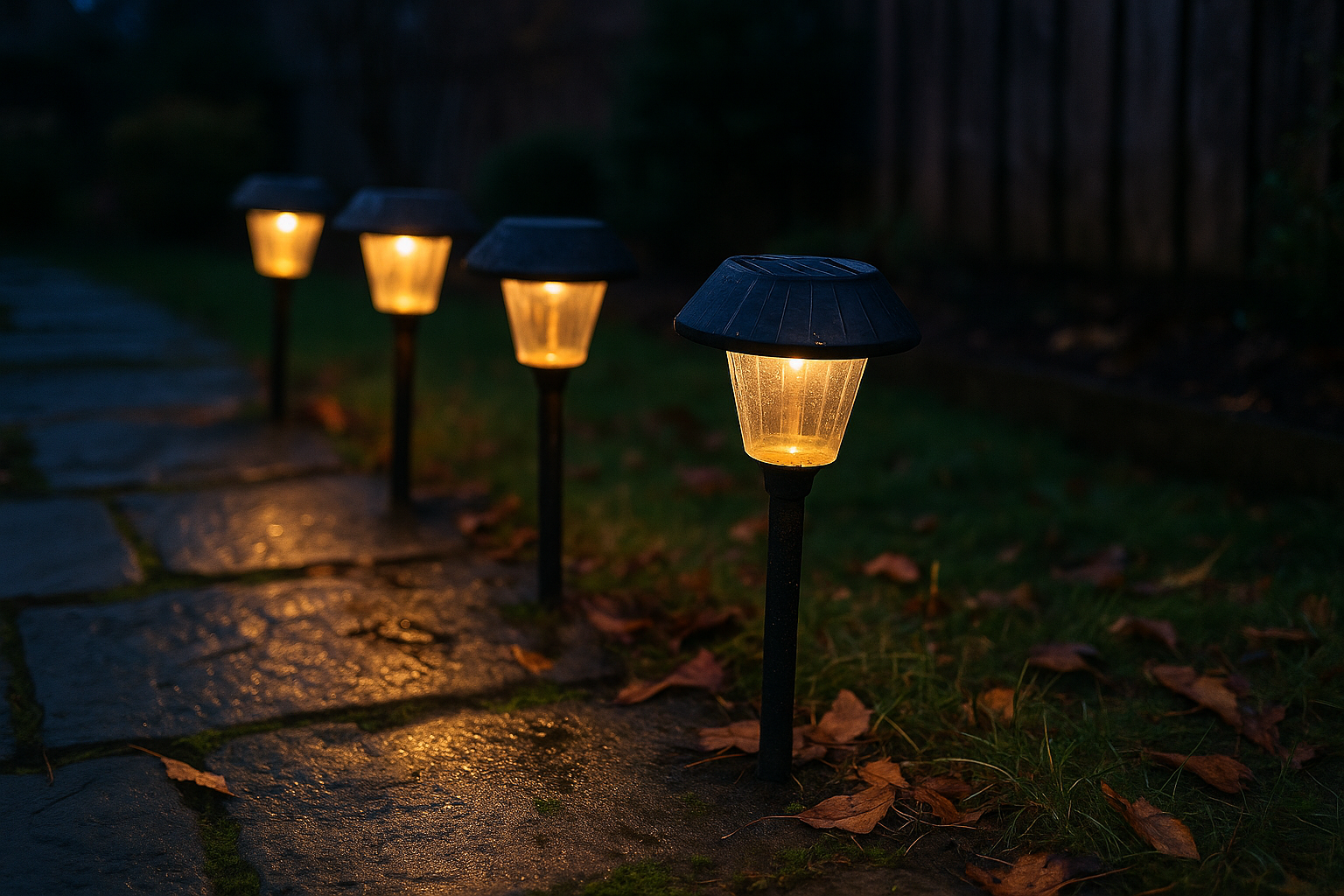
Solar lighting comes in many shapes, each tuned for a different job. Path and garden stakes create gentle, low‑glare pools that help people navigate without washing the yard in brightness. Expect roughly 10–200 lumens per fixture depending on size, with frosted lenses for comfort. Step and deck lights mount low and aim downward to reduce trips on stairs or edges. Wall lights throw illumination sideways and down, ideal for entrances and side yards. Spot and flood designs concentrate light on a tree, facade, address plaque, or driveway apron; lumens vary widely from a few hundred for accents to four figures for area coverage in larger units.
String and festoon lights are about atmosphere rather than task. Here, evenly spaced nodes paired with a remote panel lend long runs of warm white across pergolas or patios without extension cords. Because they prioritize mood, output per bulb is modest; the magic lies in repetition and placement. Specialty models fill niches: bollards with defined cutoff to limit glare, marine‑tough lights for docks with corrosion‑resistant housings, and motion‑activated security heads that leap from a sipping standby to a bright alert when movement is detected.
Choosing among these types starts with intent. Ask what you need to see and from how far, then back into output and beam shape. For comfort and color:
– 2700–3000K feels welcoming near seating and plantings
– 3500–4000K balances warmth with clarity along paths
– 5000K can aid recognition for cameras and detailed tasks
For weather resilience, look at ingress protection: IP44 handles splashes; IP65 or higher resists driven rain and fine dust. Impact ratings (often noted as IK) indicate toughness against knocks—useful near driveways or play areas.
Consider mounting constraints and sun exposure, too. Integrated units place the panel on the head, which simplifies setup but demands open sky; for shady patios, pick a model with a remote panel you can aim southward in the northern hemisphere (northward in the southern hemisphere). If tall shrubs or fences cast afternoon shade, either relocate the panel or oversize the system so it can recover on bright days. In short, align the fixture’s form and optics to the job, and align the panel’s view of the sky to your climate’s sun patterns.
Sizing, Selection, and Placement: Getting Performance Right
Good results begin with a simple energy check. Start with the target brightness and runtime, then see if panel and battery can support that budget in your location. A quick, conservative estimate goes like this:
– Convert brightness to electrical power with a reasonable efficacy (e.g., 120 lm/W)
– Power (W) × hours per night = watt‑hours needed
– Divide by expected daily solar yield after losses to size the panel
Example: You want a 360‑lumen wall light for 8 hours. At 120 lm/W, that is about 3 W. Over 8 hours, that’s 24 Wh from the battery. Assuming winter sun gives you about 2 full‑sun‑hours equivalent on average and you allow 30% losses in charging and electronics, you might need a panel capable of harvesting roughly 35–40 Wh on a clear day. A modest multi‑watt panel with decent orientation can meet that in many temperate climates.
Battery capacity should exceed a single night’s need to add margin for cloudy spells. Using the same example, a battery around 36–48 Wh provides 1.5–2 nights of autonomy. Chemistry matters: LiFePO4 maintains voltage and capacity well over many cycles, useful for fixtures that run long hours year‑round. NiMH can perform well in cold and is common in compact stakes; check that cells are replaceable or readily sourced if longevity is a priority.
Placement is everything. Aim panels toward the equator—south in the north, north in the south—and set tilt close to local latitude as a starting point. In snowy regions, a steeper angle helps shedding; in the tropics, flatter angles work. Avoid shading for the core midday window; even a slender branch can cut output significantly when cells are wired in series. If shade is unavoidable, look for fixtures with separate, larger panels or select models with bypass features that reduce the penalty of partial shade.
When comparing products, scan the spec sheet for:
– Lumens and beam angle for coverage expectations
– Color temperature (CCT) and color rendering (CRI) for visual comfort
– Ingress protection (IP) and impact rating (IK) for durability
– Panel wattage and battery watt‑hours, not just milliamp‑hours
– Controls: dusk‑to‑dawn, motion modes, dimming, and timers
– Replaceable batteries and recyclable materials for serviceability
Match these to your climate, site geometry, and lighting goals, and you’ll spend more evenings admiring the effect rather than troubleshooting runtimes.
Care, Costs, and Payback: Keep Them Shining + Conclusion
Even tough outdoor gear benefits from a little routine care. Clean panels every month or two during pollen or dust season with a soft cloth and water; opaque films from grime can trim output noticeably. After storms, clear leaves and check mounts. In winter, brush off snow and ice with a plastic scraper to avoid scratches. Inspect gaskets and weep holes so condensation can escape. Where fixtures live under trees, trim branches that cast new shade as seasons shift. Small habits extend runtime and protect batteries from deep discharges.
When performance dips, troubleshoot by symptoms:
– Dims too soon: Clean the panel; check for new shade; confirm battery age
– Flickers: Inspect connectors; reseat or replace the battery; check moisture ingress
– No motion boost: Verify sensor angle and range; remove obstructions; test at night
– Water in lens: Dry thoroughly, then reseal; consider a higher IP‑rated model if exposure is severe
Batteries are wear items. Many NiMH packs deliver a few years with nightly cycles; LiFePO4 often lasts longer. When replacements are available, changing cells can refresh a fixture at low cost and environmental impact compared with buying new.
Costs and savings vary with goals. Where an outlet already exists, the appeal may be convenience and ambiance. Where no power is present, solar can avoid trenching, conduit, conduit bodies, and landscape repair—expenses that often exceed hardware cost. Energy savings can be tangible: swapping a 60 W wired halogen that runs three hours nightly to an equivalent solar LED avoids around 60–65 kWh per year, or roughly the output of a small room air purifier operating part‑time. Depending on local electricity rates, that’s modest on its own, but paired with avoided installation work and resilience during outages, the value becomes compelling.
From a footprint perspective, each kilowatt‑hour not drawn from the grid sidesteps associated emissions. Using a notional 0.4 kg CO₂ per kWh, avoiding 60 kWh saves about 24 kg of CO₂ annually for a single replaced lamp. Multiply that by several path markers and a motion‑triggered flood, and the numbers add up. Conclusion: if you match fixture type to task, size panel and battery with a winter‑minded buffer, and give panels a quick wipe now and then, solar lights offer a reliable, stylish way to turn daylight into safe, beautiful nights—no trenching, fewer hassles, and a welcome glow that greets you every time you step outside.